
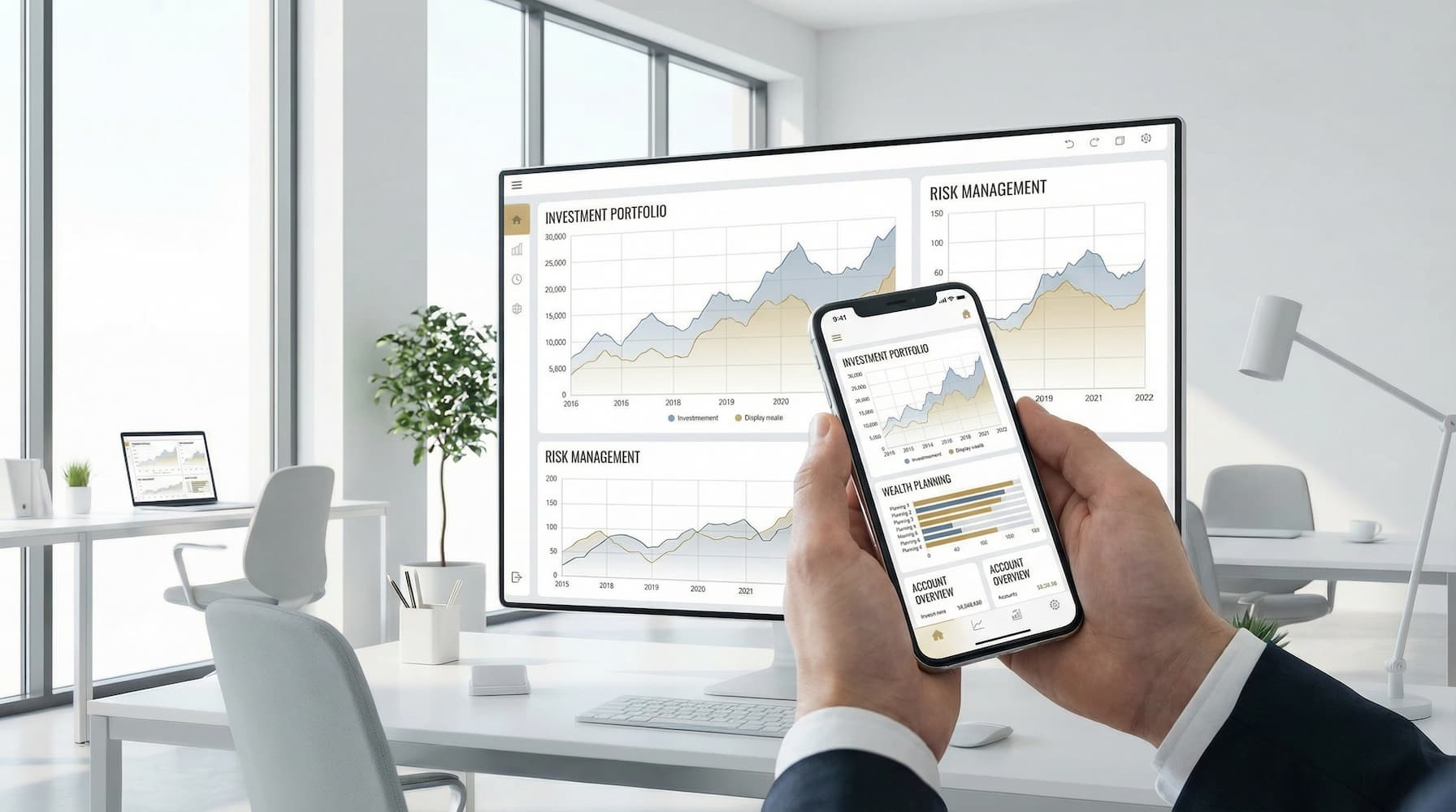
Aleta and Asora are both modern, cloud-native family office platforms, but they serve meaningfully different needs. Asora is a portfolio tracker built around clean dashboards and visual data presentation. Aleta is an AI-ready wealth intelligence platform with AI-driven document ingestion, private market forecasting, and an open architecture with public APIs and an MCP layer. Both start at roughly the same price point – Asora at approximately $900/month and Aleta at approximately $1,000/month – but the depth of capability at that price differs considerably.
Quick Comparison: Aleta vs Asora
| Feature | Asora | Aleta |
|---|---|---|
| Primary Focus | Visualization & tracking | AI automation & forecasting |
| Headquarters | Ireland (Europe) | New York (USA) |
| Team Size | ~15 employees | ~50 employees |
| Starting Price | ~$900/month | ~$1,000/month |
| Private Markets | Historical tracking | Predictive forecasting + AI Reader |
| Reporting Engine | Standard dashboards | Dashboards + Data Cube (self-service BI) |
| Data Ingestion | Manual / standard feeds | AI-driven PDF extraction |
| Open Platform | No | True open API & SQL access |
What Is Asora?
Asora is a portfolio tracking platform based in Ireland, built primarily for smaller European family offices. It positions itself as a modern alternative to spreadsheets, offering clean dashboards, broad asset coverage, and an intuitive setup process. For a family office that needs a visual upgrade from Excel and has a relatively straightforward portfolio structure, Asora delivers a workable solution. The interface is well-designed, and the onboarding process is accessible for teams without deep technical resources.
Where Asora shows its limits is in depth and scale. The platform tracks what has already happened – current NAV, past performance, asset allocation – but does not model what is likely to happen next. Liquidity planning, capital call forecasting, and predictive cash flow modeling are not part of the offering. Data ingestion for private equity documents, such as capital call notices and K-1s, typically requires manual input rather than automated extraction. With a team of around 15 people, feature development velocity and US-timezone support availability are also constrained compared to larger vendors.
What Is Aleta?
Aleta is a New York-based wealth intelligence platform purpose-built for modern family offices that need more than a tracking layer. With a team of approximately 50 people, Aleta has built a set of capabilities that go substantially beyond dashboarding: a proprietary AI engine that reads and digitizes data from PDF documents, a private market forecasting module, and the Data Cube – a self-service business intelligence layer that lets analysts filter, pivot, and build custom reports directly on top of live data.
The platform’s AI Data Reader automatically extracts information from capital call notices, distribution statements, and K-1s, converting unstructured documents into structured, queryable data without manual entry. The forecasting tools model future capital calls and distributions, giving CFOs a forward-looking view of future liquidity needs. The Data Cube allows teams to slice portfolio data exactly as needed, producing highly specific reports without relying on vendor-defined templates.
Aleta also operates as a genuinely open platform. It offers a true open API, an MCP layer, and direct SQL access, which matters for family offices that want to connect their wealth data to external tools, custom workflows, or AI applications.
Private Markets: Tracking vs. Forecasting
The core functional gap between Aleta and Asora becomes most visible in private markets. Knowing the current net asset value of a private equity position is useful, but the more operationally relevant question is how much cash will be needed for capital calls over the next quarter or year.
Asora handles private markets through historical tracking. It records what has occurred and presents it clearly. Aleta adds a predictive layer: the forecasting module models future cash flows and pacing based on fund commitments and standard industry models. Alongside this, Aleta’s AI reader ingests private equity PDFs automatically, removing the manual data entry step that Asora typically requires. For offices with meaningful private market exposure, this combination of automated ingestion and forward-looking modeling represents a practical operational advantage.
Reporting: Standard Dashboards vs. the Data Cube
Both platforms offer dashboards, and both present data in a visually clean way. The difference lies in what happens when a standard dashboard does not match what a specific family or analyst needs to see.
Asora’s reporting is built around pre-set templates. The dashboards look good and cover common use cases, but customization is bounded by what the vendor has built into the product. Aleta’s Data Cube is a different kind of tool. It exposes the underlying data in a structured, pivot-ready format that is always connected to live portfolio data. Analysts can connect the Data Cube directly to their preferred BI tool to answer complex, specific questions – filtering by entity, vintage year, asset class, or any combination – in seconds, without writing code.
Team Size and Support: The $100 Difference
For a price difference of roughly $100 per month, Aleta offers more than three times the team size. Asora operates with approximately 15 employees based in Ireland. Aleta has approximately 50 employees and is based in New York.
This gap has practical implications. A larger engineering team means faster feature development and more robust API maintenance. US-based support means response times align with EST trading hours, which matters for US clients who need assistance during the working day. Aleta is also attuned to US-specific reporting standards, including K-1 processing, in a way that European-headquartered firms often are not.
On onboarding, the difference is also notable. Lighter visualization tools like Asora often involve a significant DIY element to initial setup and historical data entry. Aleta takes a managed onboarding approach, assigning a dedicated data engineering team to clean, reconcile, and import historical data. The result is a clean, reconciled set of books from day one.
What If My Bank Does Not Have a Digital Feed?
Missing data feeds are a common friction point with portfolio platforms that rely solely on standard aggregators. Aleta addresses this directly: if a feed is missing, Aleta builds it at its own cost. For banks and custodians that still rely on paper or PDF statements, Aleta’s AI reader can ingest that data directly, ensuring 100% portfolio coverage rather than coverage limited to institutions with established digital connections.
Who Should Choose Asora?
Asora is a reasonable fit for smaller, Europe-based family offices with straightforward portfolio structures and a primary need for visual reporting. It works well as a step up from Excel for teams that do not yet require predictive analytics, automated document processing, or deep API integrations. The clean interface and accessible onboarding make it approachable for offices without dedicated technology staff.
Who Should Choose Aleta?
Aleta is suited to family offices – US-based or global – that have meaningful private market exposure, need forward-looking liquidity planning, or want to reduce manual data entry through AI automation. It is also the more appropriate choice for offices that anticipate growing their analytical needs over time and want a platform with an open architecture that can connect to other tools and workflows. At approximately $1,000/month, the marginal cost over Asora is small relative to the operational cost of switching platforms later as requirements grow.
Frequently Asked Questions

Is Aleta’s Data Cube difficult to use? No. The Data Cube is designed to be user-friendly. Think of it as a pre-structured pivot table that is always connected to live data. It allows teams to answer complex questions — such as filtering all distributions from 2024 vintage funds across specific trusts — in seconds, without needing to write code.
Why does location (Ireland vs. New York) matter? For US clients, location affects two things: support timing and data standards. Aleta operates on US time zones (EST), which means support is available during the trading day. Asora is based in Europe, which can introduce delays for US clients. Aleta is also built around US-specific reporting requirements, including K-1 processing, which European platforms often handle less precisely.
Is the forecasting feature automatic? Aleta’s forecasting tools model future capital calls and distributions based on standard pacing models. This gives CFOs a forward-looking view of liquidity needs across a 12–24 month window — a capability that basic portfolio trackers like Asora do not offer.
Do I have to set up the data myself? With Aleta, no. Aleta assigns a dedicated data engineering team during onboarding to clean, reconcile, and import historical data. With lighter visualization tools like Asora, there is typically a significant DIY element to the initial setup and historical data entry.
What if my bank or custodian does not have a digital feed? Aleta guarantees connectivity. If a feed is missing, Aleta builds it at its own cost. For institutions that still rely on paper or PDF statements, Aleta’s AI reader can ingest that data directly, ensuring full portfolio coverage rather than coverage limited to the institutions with established digital connections.