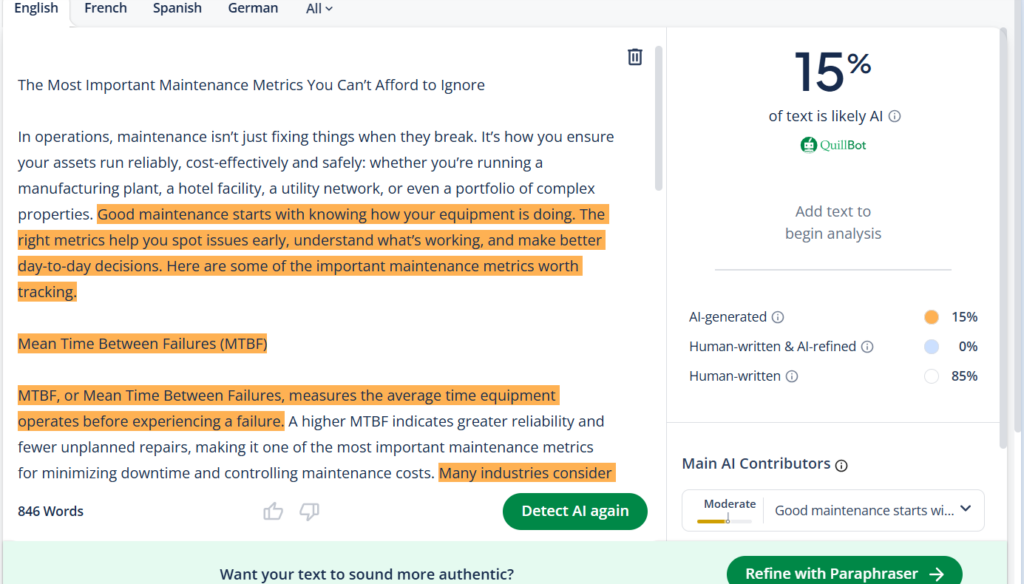

In operations, maintenance isn’t just fixing things when they break. It’s how you ensure your assets run reliably, cost-effectively, and safely, whether you’re running a manufacturing plant, a hotel facility, a utility network, or even a portfolio of complex properties. Good maintenance starts with knowing how your equipment is performing. The right metrics help you identify issues early, understand what’s working, and make better day-to-day decisions. Here are some key maintenance metrics worth tracking.
Mean Time Between Failures (MTBF)
MTBF, or Mean Time Between Failures, measures the average time equipment operates before experiencing a failure. A higher MTBF indicates greater reliability and fewer unplanned repairs, making it one of the most important maintenance metrics for minimizing downtime and controlling maintenance costs. Many industries consider an MTBF range of 500–2,000 hours a solid reliability benchmark.
Track MTBF for critical assets over consistent time intervals. When a machine’s MTBF drops, it signals you to investigate root causes (wear, overload, poor lubrication, operator error) and adjust your preventive maintenance plan accordingly.
Mean Time to Repair (MTTR)
MTTR measures the average time required to repair a failed asset and restore it to operational status. Downtime costs money, lost production, labour inefficiencies, and missed service levels. Reducing MTTR improves availability and reduces cost.
Monitor MTTR for key assets and look for trends. If repair times are increasing, check whether the issue is spare parts availability, training gaps, or inefficient workflows.
Planned Maintenance Percentage (PMP)
PMP (Planned Maintenance Percentage) is used to track the percentage of your maintenance time allocated to planned tasks versus reactive fixes. As one of the key maintenance metrics, a higher PMP indicates a proactive approach, reduced firefighting, increased control, and improved long-term efficiency.
Set monthly targets (e.g., 80% planned, 20% reactive) and track. A shift toward more unplanned work is a red flag.
Overall Equipment Effectiveness (OEE)
OEE combines availability, performance, and quality to measure how effectively your equipment is used compared with its full potential. Especially in manufacturing, food & beverage, or utilities, OEE provides a single metric that encompasses multiple loss categories: downtime, speed loss, and defect loss.

Monitor OEE at the machine, line, and facility level. Use it to identify bottlenecks, prioritize improvement initiatives, and track progress.
Maintenance Cost as a Percentage of Replacement Asset Value (RAV)
This metric indicates the annual maintenance expenditure as a percentage of the replacement value of your assets. It’s a quick benchmark of cost efficiency. If the maintenance cost is a high percentage of the RAV, it may signal aging assets, inefficient maintenance, or an oversized spares and services budget.
Compute the ratio annually. Also, benchmark it against industry norms and historical data within your organization.
Preventive Maintenance Compliance (PMC)
PMC (Preventive Maintenance Compliance) ensures the timely completion of scheduled tasks. As one of the important maintenance metrics, a high PMC reflects strong execution, fewer breakdowns, and improved asset reliability.
Track on-time completion rates monthly, set target goals (e.g., >90%), investigate overdue or omitted tasks, and address root causes (workforce, planning, materials, scheduling).
Asset Downtime
Downtime refers to the total time equipment is unavailable to produce or perform due to failures, maintenance, or other issues. Every minute of downtime affects productivity, cost, and sometimes safety or regulatory compliance.
Classify downtime into planned and unplanned categories, track by asset and cause, and aim to reduce unplanned downtime through preventive or predictive strategies.
Work Order Backlog
The backlog refers to the number of pending maintenance work orders awaiting execution. A healthy backlog means you’re keeping ahead of tasks. A huge backlog can lead to falling behind schedule, which may result in increased risk. Too low might mean under-utilization.
Monitor backlog trends, prioritize critical jobs, ensure proper scheduling, and allocate resources to avoid excessive waiting times for maintenance tasks.
Spare Parts Inventory Turnover
This measures how often you use and replace your spare parts and consumables over a period. Holding too much inventory ties up capital; too little risks operational delays. Optimized turnover means improved cost control and increased readiness.
Track turnover rates and use CMMS data to identify slow-moving versus fast-consuming parts, then adjust reorder policies accordingly.
Safety and Compliance Metrics
Includes incident rates, near-misses, compliance issues, and safety audits, reminding us that maintenance metrics aren’t just about uptime or cost, but also about reliability, safety, and preventing costly or harmful failures.
Track maintenance-related safety incidents, link them to asset condition or maintenance practices, and integrate safety KPIs into your maintenance dashboard.
Putting It All Together
The real value comes when you use the numbers to take action:
- Use MTBF and MTTR to identify weak assets and reassess maintenance priorities.
- Use PMC and PMP to shift your culture from reactive to proactive.
- Use OEE, downtime, and backlog data to drive operational improvements and cost savings.
- Use cost, inventory, and safety metrics to align maintenance with business goals, including asset longevity, cost control, and risk mitigation.
Modern CMMS or EAM systems make maintenance metrics truly actionable by capturing accurate data, generating real-time dashboards, and enabling teams to make informed decisions, rather than relying on static reports.